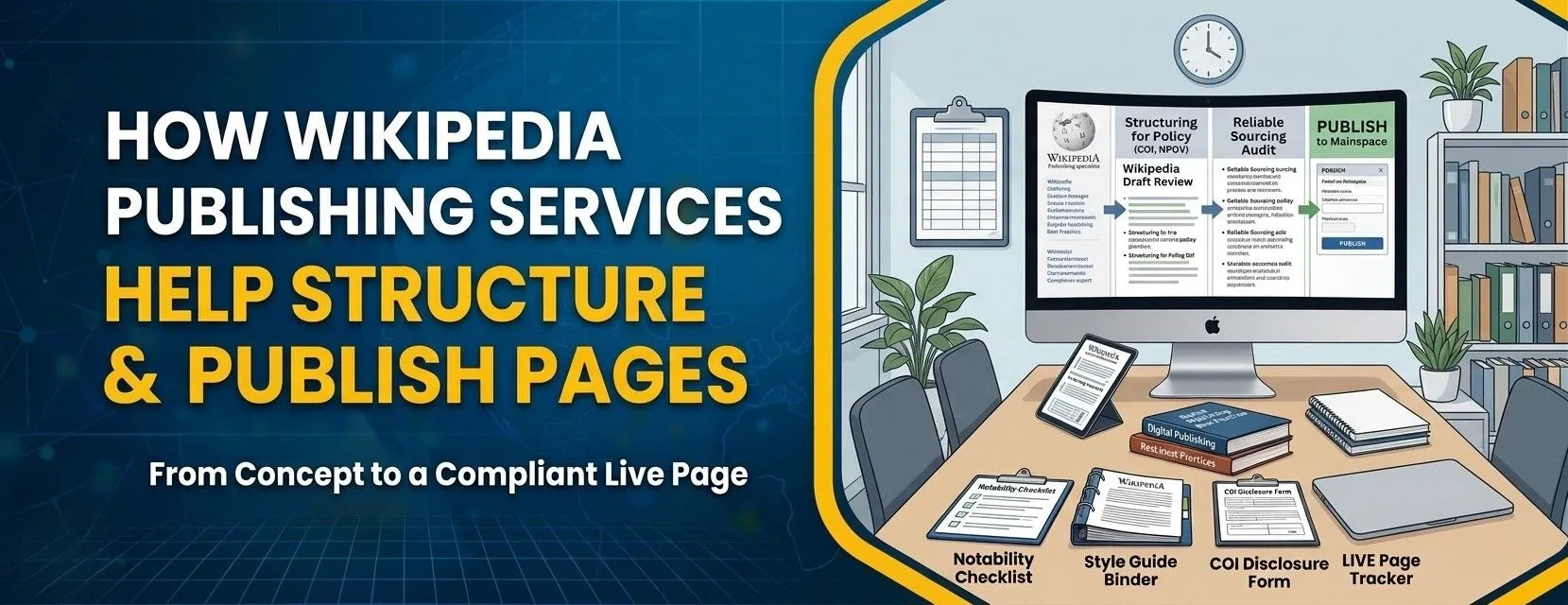
Some people assume Wikipedia is simple: write a few paragraphs, add some links, and the page goes live. But the reality is different. According to the Wikimedia Foundation, human visits to Wikipedia dropped by eight percent in 2025, while automated bot activity surged by fifty percent during that same period.
This shift signals a departure of casual users from the platform. Many now turn to artificial intelligence tools instead of editing or even reading Wikipedia directly.
In response to this shift, demand for wikipedia publishing services has risen, largely because the platform has become more difficult for ordinary people to navigate. This gap between public expectation and platform reality is where professional services enter.
This guide will help you understand how they work, what methods they practice and how you can increase your chances for Wikipedia approval.
How a Publishing Service Audits a Topic Before Building Any Page
Most beginners miss a hard truth that a wikipedia consultant starts with: a topic may be genuinely impressive, yet never qualify for Wikipedia. Only one thing matters to the platform: Notability.
How Wikipedia notability works is not obvious to outsiders, but a consultant runs the same checks reviewers will run later. Without notability fulfillment, no amount of polished writing will save the page. This is what a typical check for notability looks like:
- Google Scholar and major news archives are opened to count at least two independent sources. Each must carry real editorial oversight, such as paid fact checkers or peer reviewers.
- Any source originating from the topic itself gets removed immediately. This includes press releases, interviews, company blogs, and self-published profiles.
- A check is performed to determine whether those independent sources discuss the topic across months or years, rather than a single announcement or passing mention.
Wikimedia's own research shows that new editors quit at high rates because the technical side of editing feels overwhelming to them. But a comprehensive check for notability by an expert prevents weeks of rejection notices and clients are saved from chasing a page that was never going to be approved.
The Exact Page Blueprint Publishing Services Use
A wikipedia page creation service never starts writing without a fixed document structure in place. The reason is straightforward: Wikipedia reviewers expect information to appear in a specific order, and deviating from that order invites rejection. Below are the six building blocks these services map out before drafting:
- Lead section. Two to four sentences that answer who, what, and why someone should care.
- History or background. Events presented in straight chronological order without editorial commentary.
- Key achievements or work. Only accomplishments documented by independent third parties belong here.
- Controversies or criticism. If applicable, this section appears lower in the article, never at the top.
- Recognition and awards. Each entry requires a citation to an external announcement or official list.
- External links. A short list of official websites or archives, kept to the absolute minimum.
How They Structure the Lead Paragraph to Survive First Review
Professional wikipedia writing services treat the lead paragraph as the single most reviewed part of any page. They do this because wikipedia editors often decide whether to keep reading or hit decline within the first three sentences. Three clear steps make up the formula these services follow.- State the subject's full name and primary claim to notability in plain language without adjectives like "renowned" or "famous."
- Add the single most important fact that independent sources have verified, such as a founding year, a major award, or a documented impact.
- Close with a neutral bridge sentence that hints at what the rest of the page covers without praising or attacking the subject.
Before (what clients typically submit): John Smith is an amazing and visionary leader who transformed the industry with his groundbreaking work.
After (rewritten by a service): John Smith founded Smith Industries in 2001 and served as its chief executive until 2020. The company introduced three patented manufacturing processes between 2005 and 2010.
A lead written with promotional language rather than neutral facts reads like an advertisement and gets rejected immediately. You can see that only what independent sources can verify appears in the rewritten version.
Where Publishing Services Find Reliable Sources
Page creation services make sure that the sources published are verifiable, with editorial oversight according to Wikipedia's own verifiability policy. They know exactly where to look and what counts as a reliable source as this serves as a good starting point for any client. In practice, some places that they frequently visit to find reliable sources are as follows:
Academic Journals with Peer Review
University presses and established journal databases produce material that Wikipedia treats as highly reliable, especially for history, medicine, and science topics.
Major News Organizations with Fact-Checking Desks
Publications that employ full time fact checkers and legal reviewers carry more weight than blogs or opinion columns.
Books from Recognized Publishing Houses
University presses and commercial publishers with editorial boards leave a permanent published record that reviewers accept.
Government and Academic Institution Reports
Agencies conducting research with disclosed methodologies provide documentation that does not have a commercial conflict of interest.
Each of these source types appears on Wikipedia's internal lists of generally reliable outlets. You will also find publishers flagged as questionable, including predatory open access journals and self-published blogs, all of which are avoided by services.
How They Write Neutral Content Using Client Information
Below is the four step method these editors use to rewrite client information into neutral content.
- Every opinion word gets stripped from the client's original text. Words like "revolutionary," "best," and "visionary" are deleted immediately without exception.
- Beneath each promotional sentence, the underlying factual claim must be identified. When a client writes "pioneered sustainable manufacturing," the fact might read "installed solar panels at three facilities in 2022."
- An independent source that verifies only that factual claim must be located. No source means the claim does not belong on the page regardless of how true it seems.
- A single sentence stating the verified fact is written using no adjectives and no emotional language. The resulting sentence should read like a documented fact, not a marketing brochure.
Around sixty eight percent of all Wikipedia drafts fail during review. Most of those rejections may be attributed to the usage of promotional tone rather than neutral. What you can do is to read a short paragraph after completing the four steps.
This serves as a quality check. You have to delete any sentence that could appear on a company's "about us" page and rewrite it to ensure neutrality.
How They Handle Conflicts of Interest Legally
Wikipedia operates under a simple legal requirement that many clients do not know exists. Anyone paid to edit must disclose their employer, client, and affiliation publicly on the platform. When you hire a service, a consultant working on behalf of a client follows this disclosure rule exactly to avoid account blocks.
The disclosure appears in one of three places: on the editor's user profile page, on the talk page attached to each contributed section, or written directly into the edit summary box when saving changes.
Failing to disclose paid status is prohibited by the Wikimedia Foundation's terms of use. This is why accounts that hide paid relationships are blocked by administrators.
Many clients ask consultants to "just fix a few words" without going through formal disclosure. But a legitimate consultant refuses this request. They are aware of how Wikipedia editors evaluate sources and do what's acceptable as this is part of ethical paid editing.
The Publishing Service Submission Workflow
A wikipedia publishing service cannot move a finished draft directly onto the live encyclopedia. This path is blocked by Wikipedia for any editor with a conflict of interest. The service should follow a submission workflow that takes approximately thirty days from start to finish.
- Step one: Sandbox drafting. The entire page is built inside a private workspace attached to an editor account. No member of the public sees this version.
- Step two: Internal peer review. Before submission, a second editor at the service reads every sentence and checks every citation against Wikipedia's source guidelines.
- Step three: Articles for Creation submission. A submission tag is added to the draft. A volunteer reviewer then places it in a queue where the average wait time reaches nearly thirty one days.
For a realistic view of the entire timeline, how long it takes for a Wikipedia page depends almost entirely on whether the draft passes review on the first attempt.
What a Service Does When a Page Gets Declined
Professional editors available for freelance Wikipedia work do not panic or abandon the project at this stage. Instead, they follow a response system as detailed in the columns.
| Decline Notice | What It Actually Means | What the Editors Do Within 48 Hours |
|---|---|---|
| "This draft does not demonstrate notability" | The sources fail Wikipedia's three tests: significance, reliability, and independence from the subject. | A second search is opened for independent sources that discuss the topic directly across multiple paragraphs. |
| "Insufficient reliable sources" | The citations come from blogs, press releases, or the subject's own website rather than newspapers or academic journals. | Each flagged source gets replaced with material from major news archives or university presses. |
| "Promotional tone" | Adjectives like "leading" or "innovative" appear anywhere in the text. | Every descriptive word that praises the subject is deleted, and each claim is restated as a bare fact. |
The key principle is simple: if sufficient reliable, independent, secondary sources do not exist for a topic, no amount of editing will get the page approved. The team you hire should always know when to deliver that honest answer to a client as this is part of what the best service provides.
Is a Wikipedia Publishing Service Worth the Investment?
A wikipedia consultant does not guarantee publication when hired, but they can help you avoid the most common reasons that make drafts fail: poor structure, promotional language, inadequate sources, and undisclosed paid editing.
As shown by research, wikipedia has a sixty eight percent rejection rate, with only twelve percent approval rate for business executives, and a six percent success rate for startups.
A stark reality is that wikipedia's volunteer reviewers cannot be controlled by any service but what you can control is whether or not your draft arrives in their queue with all the qualities that qualifies your draft for approval.
When searching for a paid service, always ask to see any provider's source verification checklist and their process for handling a decline notice before paying. This saves you from an unwarranted headache and a loss in funds.
Frequently Asked Questions
Can I pay someone to guarantee my Wikipedia page gets published?
No credible wikipedia publishing services offer guarantees of publication. They can help you make your draft strong and prevent costly mistakes. The final approval, however, rests with reviewers who decline a significant number of the drafts daily.
What is the difference between a Wikipedia page creation service and a freelance writer?
A wikipedia page creation service hires multiple editors who review each other's work. These editors maintain knowledge of current notability guidelines and track policy changes. On the flip side, a freelance writer working alone may not stay current with Wikipedia's evolving rules.
Do I have to tell Wikipedia that I hired an editor?
Yes. Paid editors are required by the Wikimedia Foundation to disclose their employer, client, and affiliation publicly. This disclosure is handled on your behalf by professional wikipedia editing services through user page statements or edit summaries. Failure or negligence in transparency may cause account blocks and page deletion.
How do I know if my topic is worth pursuing?
You can run three checks to examine for notability before any client is accepted: independence, significant coverage and reliability. If hiring a service, the wikipedia consultant declines the work if those checks fail, because no amount of editing can overcome a lack of notability.
What is the single biggest mistake beginners make?
They look for sources after writing. They may bypass the fact that what can be written is determined by sources, not the other way around. The page will never be approved regardless of how well someone writes it if sufficient reliable, independent sources do not exist for a topic.