You type a name into Wikipedia fully expecting to find a page waiting for you. But instead, the search comes back empty. That moment generates confusion for most people.
This article walks through how content gets approved or "noted" by Wikipedia for it to appear in search results. It explains exactly how Wikipedia notability works in practice and why the Wikipedia community rejects most submissions they receive.
What Wikipedia Notability Actually Means
Wikipedia functions completely differently from social media or personal websites. It isn't simply a catalog for everyone who exists or everything that happens in the world. Instead, the Wikipedia community developed specific notability guidelines over many years of operation.
These inclusion rules determine what content stays and what ultimately gets removed. They don't really care about awards or industry recognition, at least not directly. This selection process for pages and information published on Wikipedia is called Wikipedia notability.
Wikipedia Notability Criteria Explained
This knowledge becomes essential before you ever attempt to create a Wikipedia page. Our How to Create a Wikipedia Page guide has the details you need to get started. Then you'll better understand what to do to get your page noted.
Even if you hire a wikipedia page creator, the same rules apply to everyone equally; no special treatment exists simply because someone gets paid to produce the draft submission.
The Wikipedia notability criteria has three filters for basic checks based on official general notability guidelines (GNGs) and meeting them all can increase your chances of getting approval from the editorial team. These are as follows:
Significant Coverage
The subject should have significant coverage.
This filter demands that the source must address the topic directly with significant coverage. This means that a single mention buried inside an article won't meet Wikipedia's requirement.
Instead, the source needs comprehensive coverage that treats the topic as its main theme. In simple words, Wikipedia requires in-depth coverage that puts the topic as the primary subject of discussion.
Example of Insufficient Coverage:
Someone is aiming to publish a wikipedia page for a particular personality and they choose a local news story covering a town festival organized by the person as the coverage, but nothing else covers their work besides a brief mention of their name at the bottom.
Wikipedia will not accept this as significant coverage for the primary subject which in this case is the personality being covered.
What Turns It into Significant Coverage?
Mentioning the full profile of the said subject's background, their work, and their effect over years. This is because editors search for feature articles and in-depth coverage that explore who the person is, what they built, and why anyone should care, all pulled from multiple sources for comprehensive coverage.
Reliable Sources
The subject's content should have reliable sources.
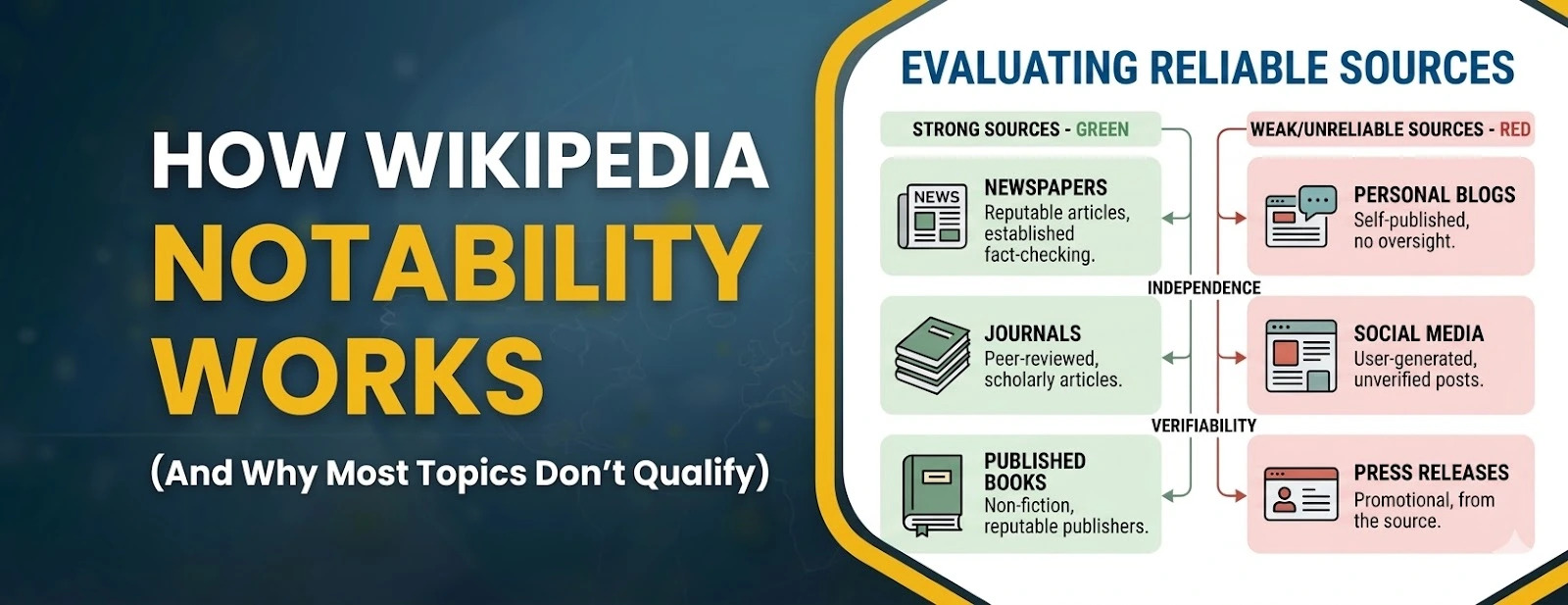
Not all sources share equal weight on Wikipedia, so the platform has listed its own reliable sources. These are credible publications with reputations for accuracy and fact-checked content.
Examples of Reliable Sources Include:
- Major newspapers such as The New York Times or The Guardian keeping strong editorial standards
- Well-known magazines like Time or Forbes using professional journalism as normal practice
- Academic journals requiring academic peer review before any work gets printed
- Books from university presses or trusted publishers with firm editorial boards
Examples of Unreliable Sources Include:
- Personal blogs where anyone posts anything without accuracy standards
- Press releases controlled fully by subjects looking for attention
- Personal websites missing any editorial oversight or checking process
- Social media posts and forum threads filled with user-generated content
- Self-published material that skips all outside review
- Company blogs and promotional content built to sell rather than inform
- Paid placements and press release distribution where money buys visibility
- Anonymous posts carrying zero responsibility for accuracy
Wikipedia evaluates sources by checking whether the publication has editors, whether they verify facts before publishing, and whether the outlet is established with a proven track record. If any of these requirements are missing, Wikipedia rejects the source.
Independent Sources
The subject's content should have independent sources.
Independent sources cannot be controlled by the subject under any conditions. This rule stops people from building their own proof. When assessing for approval, Wikipedia therefore demands independent sources of content with nothing to gain or lose.
Examples that do not count as independent sources:
- Official company websites and press releases filled with promotional content
- Self-published articles written by subjects offering no detached reporting
- Sponsored content where payment got the spot, missing unbiased reporting
- Interviews where subjects give every answer without objective journalism
- Any material put out by the subject's team, representatives, or paid supporters
Editors seek disinterested parties who gain nothing from good coverage. They want journalists, researchers, and critics working without any tie to the topic.
Wikipedia reviewers and editors therefore expect a neutral point of view that presents facts plainly without hype. This arms-length coverage gives the independence that satisfies the Wikipedia notability criteria.
Who Usually Qualifies for a Wikipedia Page
Apart from the general notability guidelines, there are subject-specific notability guidelines (SNGs) that provide more targeted criteria for certain types of topics. These guidelines have to be adhered to or else you risk getting your submission rejected.
That is why knowing the common reasons for rejection can save time and prevent frustration down the road. If you want to study in depth, we have prepared a detailed guide about Why Wikipedia Pages Get Deleted.
The SNGs help determine notability for specific categories like politicians, academics, or creative professionals. Here are the examples who would qualify through this route:
Public Figures
Public figures: Notable people on Wikipedia become eligible for Wikipedia notability when their roles bring real media coverage their way. This group includes:
- Politicians who held national office or served inside legislative bodies long enough to attract attention
- Judges whose decisions on significant courts drew outside notice
- Widely known activists when their work generated sustained media attention across multiple news cycles
- Notable media personalities with actual track records in television or established publications
Authors, Artists, and Creators
Writers, filmmakers, musicians, and other creative professionals make the cut for Wikipedia when their work makes outsiders pay attention. For example, major publications running critical reviews looking at their books or when film critics working for respected outlets write seriously about their movies.
Companies and Organizations
Businesses can absolutely get Wikipedia pages under the right conditions, but they must meet Wikipedia notability requirements for businesses through real independent press coverage built up over time. This means:
- Articles in major newspapers, business publications and respected industry journals
- Coverage from sources with zero connection to the company itself
- Outside scrutiny looking at what the business actually does behind its marketing
Smaller local businesses almost never qualify unless they built sustained regional media attention over months or years.
Academics and Researchers
Academics follow a different path where notability comes from scholarly recognition rather than traditional media coverage. Their notability comes instead from scholarly recognition built inside their specific fields. This can mean:
- Published research that gets heavy citations from other working scholars
- Major academic awards given at the national level by peer organizations
- Distinguished professor chair posts at research universities
- Editor position inside well-known academic journals
Publishing alone is not enough for Wikipedia coverage. The work itself must have changed how people inside the field understand their subject, like researching a topic not yet explored.
How Wikipedia Editors Evaluate Notability
As stated above, editors typically use three filters when assessing a submission for wikipedia notability.
- Independent sources/ Neutrality of Content
- Reliability of publications
- Depth of coverage
Articles for Creation (AfC) Review Process
Editors work in collaboration with volunteer reviewers to make sure each submission satisfies the Wikipedia notability criteria. Each volunteer reviewer compares the submission carefully against established page guidelines before submitting it to the editorial team for the final call.
All this checking happens during the Articles for Creation (AfC) review process, which is the standard new pages process to get published on the platform. This process takes time because real people look at everything personally before making a decision. You can see Who Writes Wikipedia Pages for insights on how Wikipedia submission and approval work and who edits the pages.
Common Misconceptions About Wikipedia Notability
Here are the biggest myths about what makes someone notable for wikipedia and their truth that exists in reality.
Myth: "Being Successful Means You Qualify"
Truth: You can be the best in your area and still not get a page. The real question comes down to media coverage, specifically whether independent journalists have looked at your work.
Myth: "Having Many Online Mentions Is Enough"
Truth: Hundreds of blog posts or social media mentions or even local news briefs that just give a passing mention do not help. What matters is substantial coverage from sources that have editorial oversight, particularly secondary sources with editors and fact-checkers.
Myth: "Paying Someone Guarantees a Wikipedia Page"
Truth: A wikipedia consultant can explain how things work. They can walk you through notability guidelines and tell you what the Wikipedia community expects. What they cannot do is make the editors give approval. The rules apply to everyone, and editors decide approval based on a set of pre-defined criteria.
Can Professionals Help With Wikipedia Notability?
What professionals actually do:
- Source evaluation — They look at what you have and compare it to what works. From there, they tell you honestly before you spend too much time on this.
- Draft structure — They put things in the order Wikipedia expects because how things look matters.
- Content policy guidance — They explain the requirements for approval. This helps you avoid mistakes that get pages rejected fast.
Important limitations to understand:
Payment for wikipedia services gets you knowledge from professionals who know how things work. It does not guarantee you page approval because community consensus and editorial approval decide what happens at the end.
How to Determine If a Topic Is Likely to Qualify
Here is how to check who qualifies for a wikipedia page against the wikipedia notability criteria.
Step 1: Search for independent media coverage
Look for topics with independent coverage. This means independent reporters chose to write about this on their own.
Step 2: Evaluate the reliability of those sources
The information must be sourced from reliable sources. This includes big newspapers or established publications that have been around for a while, academic journals that check their facts, and books from recognized publishers. They should not be company pages passing along press releases.
Step 3: Check if the coverage is significant
The coverage should contain significant information covered by independent and reliable sources. It should not just be brief mentions.
Step 4: Compare similar Wikipedia articles
Find pages for people or companies like yours, then look at what sources they used. This is because similar articles show you what worked before.
Final Thoughts - Treat Wikipedia as an Encyclopedia
Here is the bottom line when it comes to wikipedia notability. Wikipedia is an encyclopedia, not a marketing publication. Its approval team doesn't value awards or being well known directly, but through reliability, independence, and neutrality of sources and substantial or in depth coverage, meaning major sources for a given area of work.
Examples include newspapers, journals, and books covering something in depth. And so, fulfilling this criteria is what decides page qualification. Once you see how wikipedia notability really works, you will understand what goes into getting your page published.
FAQ Section
Can a business have a Wikipedia page?
Yes, but only if independent sources have written about it in detail. This does not include press releases and company blogs because the coverage must come from outlets with editorial oversight, like major newspapers or industry journals.
How do editors decide if a topic is notable?
Editors check three things when they look at a topic. First, coverage that talks about the topic directly and in depth. Second, reliable sources known for fact checking before publishing. Third, sources that are independent. If those three exist, the topic likely meets the wikipedia inclusion criteria.
What happens if you falsely edit Wikipedia?
Editors will revert changes and put back the correct information when false edits appear. If someone keeps adding false material, especially about living people, they can face editing restrictions or get blocked entirely.
Can anyone just edit a Wikipedia page?
Yes, anyone can edit, but changes must come from verifiable sources that readers can check. If someone has a conflict of interest, like being paid by the person or company they are writing about, they have to say so openly. The same rules apply to everyone without exception. You can study about this more in our guide How to Edit a Wikipedia Page.
What are the notability requirements for Wikipedia?
The main core requirements are in-depth coverage in multiple reliable secondary sources that are also independent. Different types of topics like biographies, companies, or creative works have extra subject-specific guidelines, but they all go back to that same basic rule.