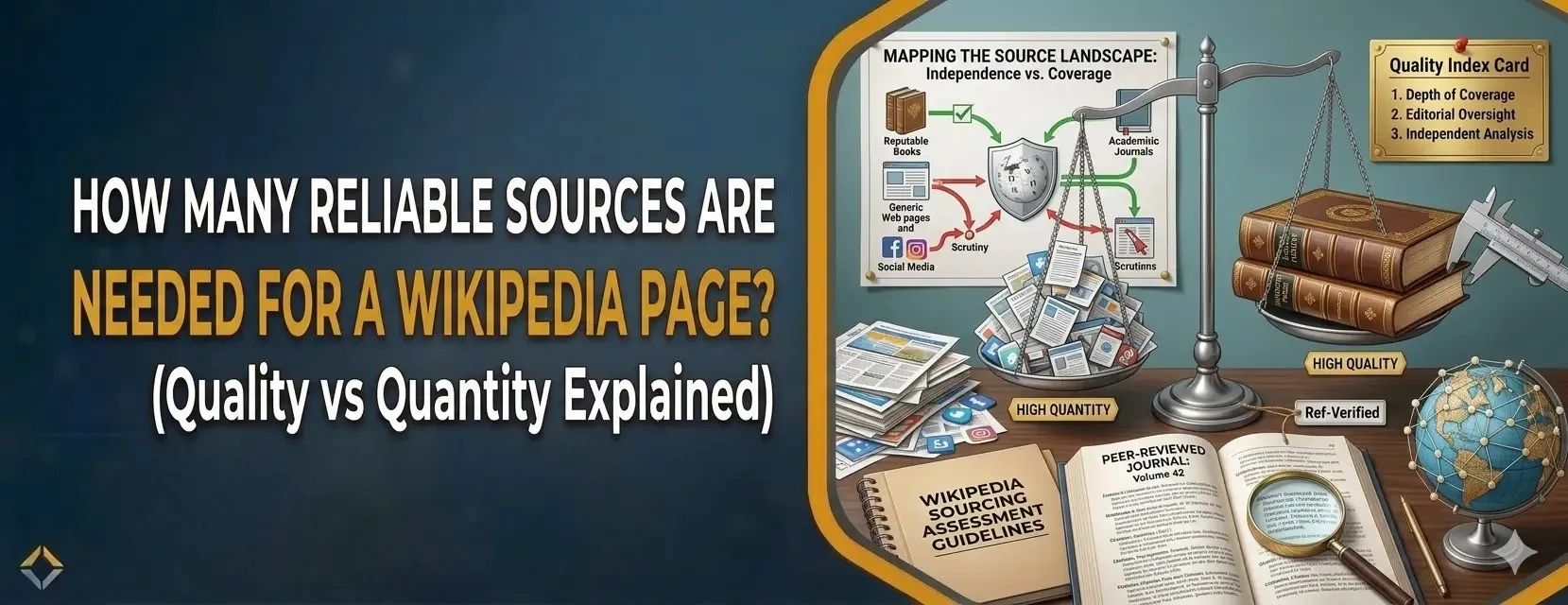
Many individuals who attempt to create a wikipedia page are failing to recognize that the platform is operated in a manner entirely unlike social media or a standard blog. One cannot simply write several paragraphs, click publish, and then expect immediate visibility.
The first obstacle most newcomers encounter involves gathering wikipedia reliable sources that independent editors actually trust. Without such sources, a draft will most likely remain ignored or face removal altogether.
What does it take to make progress? This entire process is confusing even for experienced writers. But having a grip on fundamental rules, on the other hand, brings much needed clarity.
You will learn exactly how many sources does wikipedia need, how to look for the right sources and what elements you can improve right now to strengthen your submission. Waiting for approval, by the end, should feel less like guessing and more like following a well understood path.
How Many Sources You Actually Need (The Minimum and Maximum)
A common mistake among newcomers involves piling on as many citations as possible. According to wikipedia's internal guidelines, this approach often backfires. This is why it is critical to understand How Wikipedia Notability Works before you start writing or collecting sources.
Here is a simple tiered guide based on topic risk:
- Low-risk topics (e.g., basic historical dates, plot summaries). Three independent sources usually satisfy wikipedia's requirements. Focus on finding two or three solid references rather than ten weak ones.
- Medium-risk topics (e.g., company histories, biographical details). Four or five sources provide a safer margin. Spread these across different publication types and time periods.
- High-risk topics (e.g., living people, controversial claims). Five or six sources may be necessary. That said, every single one must pass the quality checks for a reliable source (What Counts as a Reliable Source for Wikipedia).
How Many Citations to Attach Per Fact (And When to Stop)
When you write for wikipedia, you have to know the limit of citations you can add for a fact. The wikipedia notability requirements do not demand a dozen sources for a single statement. In fact, excessive footnotes confuse readers and make the article harder to edit later.
You should enter the citations using this quick-reference guide for per‑fact citations:
- One source. This works for uncontroversial claims, basic facts, and statements supported by a single authoritative reference. Avoid adding extra citations just for the sake of volume.
- Two or three sources. Use this range when demonstrating that multiple authorities agree on a point. This range also helps when relying on sources that are moderately reputable but not universally trusted.
- Four or more sources. This level triggers editor scrutiny. Wikipedia's own community notes that inexperienced editors sometimes add excessive citations to compensate for a lack of genuine notability. Reviewers may add objections and question whether the subject belongs on wikipedia at all.
When one source is enough
Example 1: Well‑known historical event described in a standard history textbook.
Example 2: Mathematical formula verified by a single peer‑reviewed paper.
Example 3: Direct quotation from a public government document.
Adding a second source in these cases does not strengthen the article. It simply adds clutter. This is one of the reasons why you should understand Why Wikipedia Pages Get Deleted and stay away from the red flags that editors look for.
How and Where to Check For Quality Sources
What looks perfect to a newcomer can, in practice, raise immediate concerns for those who evaluate pages on a daily basis – wikipedia editors. The most effective approach involves verifying your own materials using the same criteria that editors apply.
Step 1: Ask who published it
Whenever a company, a public relations firm, or the subject of the article has participated in the creation of the material, editors will reject it without hesitation. If the content or source is not independent, discard it. You must do this to satisfy the independent sources requirement.
Step 2: Look for the same information
Search for similar information across two unrelated wikipedia reliable sources. Nowadays, automated systems flag weak citations instantly. When editors observe an identical claim supported by two completely separate and independent outlets, trust begins to form. Though a single strong source is worth more than ten weak sources, adding two will strengthen your manuscript.
Step 3: Ignore the brand name and focus on the byline
A well-known website means very little if the individual writing the piece lacks editorial oversight. Editors routinely bypass the logo and examine the fine print. The demand for scholarly references has grown substantially in recent years; therefore, relying on weak or questionable sources is no longer a viable strategy.
Here are types of sources that wikipedia editors consistently trust:
- Peer‑reviewed academic journals
- Major news organizations with a public fact‑checking policy
- Government or university publications
- Books published by established academic presses
Pre-Submission Checklist for Reliable Sources
Wikipedia's Reliability page affirms that minor errors in high-visibility articles are often corrected within minutes to days if flagged early, with the highest correction rates in the first 24 hours due to New Pages Patrol.
To catch this window, meeting the wikipedia notability requirements demands a structured approach you apply during drafting. Use this step-by-step checklist to identify reliable sources and build a strong article before submitting to Articles for Creation (AfC) or mainspace:
Step 1: Basic Coverage (First Hour Check)
At least one citation must be attached to every claim in your first three paragraphs. For living persons, wikipedia practices protection with a specific deletion pathway called BLPPROD which is triggered by articles with zero citations. This is often the fastest route to deletion, so do not ignore it.
From your source list, remove any press release or company announcement. During the first hour of patrol review, these materials trigger speedy deletion. This type of nomination leaves very little time for corrections.
Step 2: Verify Depth (First Few Hours)
For your most important factual claim, add a second independent source. Shown by research from wikipedia's own review guide, the proposed deletion process can be blocked by a single citation that has significant coverage.
Under current review standards, brief mentions or passing references do not count as significant coverage. These kinds of shallow citations will not save your page.
Step 3: Diversify Sources (First Day)
Look for more sources published by a different type of organization. For example, combine a news article, a government report, and an academic paper. When you use a variety of publication types, the overall citation profile is strengthened. Doing this makes your reference list harder to dismiss.
Also remove any source where the author has a direct connection to the subject. During the assessment phase, non-independent materials are explicitly flagged by review documentation. They are treated as conflicts of interest, regardless of content quality.
Step 4: Confirm Strength (First Week Audit)
After all filtering, confirm that at least three sources remain. To articles meeting this threshold, wikipedia's proposed deletion pathway cannot be applied. In other words, three solid references serve as your shield against PROD.
In case significant sources cannot be located, set the page aside. And always respond to editor comments because once the seven-day PROD window passes uncontested, editors may redirect or delete the article. This outcome can be avoided by following the steps above in your draft before submission.
When To Use a New Source Over an Old One
Not every recent article outperforms an older publication. In fact, Wikipedia's guidelines emphasize depth and independence over novelty. Only in specific cases should newer sources replace older ones.
This includes: breaking news, updated scientific consensus, or recent legal rulings. For most other topics, the older source with established fact‑checking is usually sufficient. To understand how to evaluate a topic's readiness for wikipedia before you start, review How to Check Notability Before Creating a Page.
What to Do When You Only Have One Good Source
Finding only one strong reference does not mean your article is doomed. The wikipedia notability guidelines allow combining multiple independent sources. Below are four actionable strategies for building a credible citation list from a single starting point.
- Mine the bibliography of your existing source. Academic papers, books, and investigative journalism pieces list their own references. Each cited work inside that list may lead you to a new source.
- Search for coverage published at least six months apart from your first source. Wikipedia looks for sustained attention, not a single burst of publicity. Look for a second article from a different year as this suggests lasting significance.
- Look for sources in different publication categories. Combine a news article with a government report, a book, or an academic journal. This variety across publication types strengthens your overall case.
- Check whether your topic has received awards or honors. Nobel Prizes, MacArthur Fellowships, Olympic medals, or national office often generate independent coverage. These distinctions can point you toward additional reliable references.
What to skip: Press releases, interviews, the subject's own website, and Q&A articles. None of these count as independent sources. They may verify facts but do not establish notability.
Conclusion – The Final Number + Quality Checklist
After working through the steps above, you now have a clear idea on how wikipedia does not reward the number of citations but a high quality set of strong references that satisfy wikipedia's notability criteria. Here is the final guideline on the quantity and quality of sources for reliable sources wikipedia.
Final quantity guide:
- Low-risk topic → 3 sources minimum
- Medium-risk topic → 4–5 sources
- High-risk topic → 5–6+ sources
Final quality checklist (verify before publishing):
- Source independent (not written by the subject)?
- Publication known for fact-checking?
- Author identified and credible?
- Coverage significant (more than one paragraph)?
- Publication date appropriate for the topic?
Frequently Asked Questions
1. Can I use one really good source from a major newspaper like The New York Times?
You have to make sure that it satisfies the platform's requirement for significant coverage. This usually is achievable if you use multiple independent publications.
2. What happens if I add ten or fifteen citations to prove my point?
No. This is not a good strategy as Wikipedia's internal guidance has already warned that inexperienced contributors sometimes overload an article with footnotes to mask a lack of real notability.
3. Does an interview count as a reliable source?
No. Interviews lack independence because it's a primary source. Even when published by a trusted news outlet, an interview reflects the subject's own words rather than objective reporting.
4. How quickly will editors review my sources?
This depends on multiple factors but if your topic has a good number of editors available, it will receive a review within days or weeks.