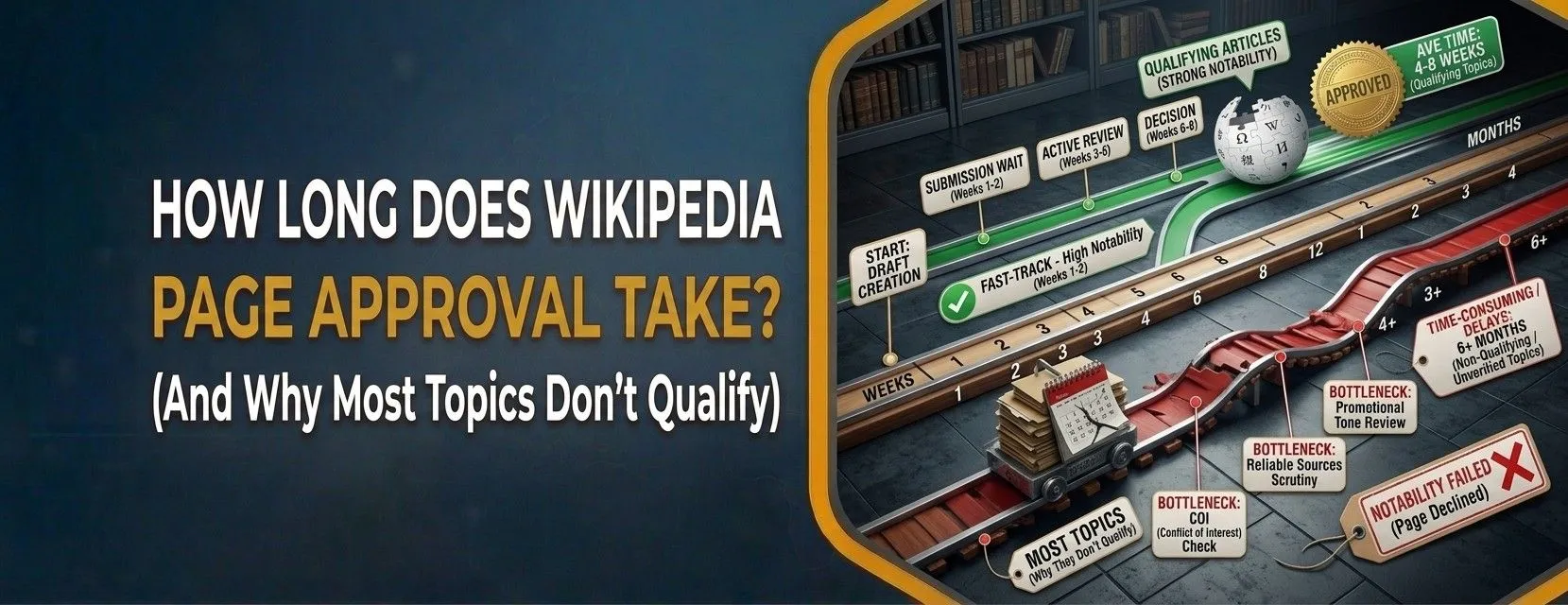
Waiting on a Wikipedia page approval can feel like a prolonged process without clear resolution. You may have submitted a well‑researched draft days or even weeks ago, yet no response has arrived. This lack of communication can feel frustrating, especially when no customer support desk exists to call or email.
According to community‑maintained tracking pages, the AfC queue currently holds roughly 4,000 to 4,500 pending drafts, processed by a few hundred volunteer reviewers across the English‑language Wikipedia. This explains why delays are expected rather than unusual.
This article cuts through the confusion by explaining exactly how the review system operates, why wait times vary so dramatically, and what you can realistically expect moving forward.
Why Thinking There's a Customer Support Queue Is Wrong
Here is what newcomers frequently misunderstand about wikipedia approval time: the platform does not operate like a call center or a help desk.
As confirmed by official Wikipedia project documentation, articles may remain unreviewed for several months; legitimate editors will never offer to accelerate the process in exchange for payment. With that in mind, consider these three realities:
- No queue exists by design. One submission from last month and another from yesterday could be reviewed on the same day. Official policy warns that anyone offering to remove the "not reviewed" message for money is running a scam.
- Reviewer availability fluctuates. Even a sudden drop in volunteer activity extends wait times for everyone directly. These volunteers must meet strict requirements: at least 90 days of registration, 500 mainspace edits, and a clean block record for six months.
- Quality never guarantees speed. Even a perfectly sourced, neutral article waits just as long as a flawed one as there is no binding agreement for the reviewers.
You are not waiting for a representative but for a volunteer to notice your draft among thousands of others.
The Backlog Trap: Why Your Topic Area Matters More Than Your Writing Quality
Why wikipedia pages get delayed requires looking past grammar and into how Wikipedia organizes its labor force. This explanation will help you see why topic selection matters so much.
Active Versus Inactive WikiProjects
Volunteers cluster around WikiProjects, which are informal teams focused on specific topics. For example, a WikiProject dedicated to military history may contain thousands of active editors, whereas a project covering Belize or skyscrapers might see activity only once every few months.
For a totally clueless newcomer, this means submitting a draft about a little‑known Belizean musician guarantees a longer wait than a draft about a World War II aircraft.
Real Backlog Comparison
Numbers illustrate the gap clearly. As of March 2026, roughly 39,000 articles tagged as completely unreferenced sat waiting for attention alongside another 29,000 probably unreferenced pages.
At a clearing rate of several tens of articles per day, that backlog alone would require more than a full year to process. This is why choosing a topic covered by an active volunteer group gives you a hidden advantage that no amount of polished prose can replace.
How Wikipedia's Risk Assessment Prioritizes Your Draft Before an Editor Arrives
Before any human reads your first sentence, an automated system has already decided how urgently your draft needs attention. This pre‑screening shapes wikipedia draft review time more than most writers realize.
Automated Risk Signals
Wikipedia uses a scoring tool called ORES to flag potential problems immediately. These signals determine where your draft lands in the review queue:
- Attack page patterns – Language targeting living persons triggers the fastest possible review, though usually for deletion rather than approval.
- Promotional wording – Phrases that read like an advertisement send your draft to a high‑priority queue for advertising reviews.
- Missing references entirely – Submissions with no citations at all get flagged for unreferenced article checks.
- No categories assigned – A draft without topic categories appears orphaned in the system and receives lower visibility.
You should avoid each of these signals if you want faster processing.
The Math of Waiting: Calculating Your Real Timeline Based on 3 Variables
No single answer exists for how long does wikipedia review take because each submission carries its own weight. Instead of guessing, you can calculate a realistic estimate using three factors added together.
Here is the simple formula: Topic Risk + Source Quality + COI Status = Timeline. You can apply this formula to your own draft before submitting it.
Topic Risk
Some subjects carry more risk than others. For example, a draft about a pharmaceutical company faces more scrutiny than one about a 19th-century poet. This is because industries attract vandalism and promotional editing.
Reviewers therefore spend extra time verifying claims in high-risk categories such as finance, health, politics, and multi-level marketing. But low-risk topics like historical figures or geographic locations typically receive faster decisions.
This distinction means you should honestly assess your subject's risk level before estimating your wait.
Source Quality
References from independent newspapers or academic journals allow a reviewer to confirm notability within seconds as these effectively fulfill wikipedia's notability requirements.
On the other hand, a draft with press releases, company blogs, or sponsored content does the opposite, forcing the reviewer to hunt for better sources themselves.
You can accelerate your timeline by replacing weak sources before submission rather than waiting for a reviewer to do it.
COI Status
Conflict of interest declarations also influences reviewer behavior. For instance, a draft submitted by someone with a disclosed paid relationship may receive closer inspection, but if the reviewer team discovers an undisclosed conflict, the submission will face immediate rejection and a longer delay than any other factor.
For more details, see the Wikimedia Foundation's disclosure requirements. You should always practice transparency as this protects you from being flagged as a bad actor.
Why Pages About Living People Move Faster Than Company Pages
Wikipedia prioritizes biography of a living author over a profile of a small software company when in the same queue. Wikipedia Page Creation timeline differences become clearer when examining how reviewers assess each category. These differences directly affect how long you will wait for a decision.
For example, one company draft titled BetterSleep contained made-up references and citations with misleading titles taken from paid ad placements. This is why reviewers have learned to assume bad faith with company drafts until proven otherwise. You should anticipate this skepticism when submitting corporate content.
Why the Gap Exists
To get a fuller picture, you might review how Wikipedia notability works. The core reason comes down to statistical reality.
For instance, you will find more company pages containing promotional language, undisclosed paid editing, and single-purpose accounts created solely to advertise.
On the other hand, living person biographies are processed faster because the drafts mostly fulfill notability requirements. You can avoid this delay in timeline by ensuring your company draft reads like a neutral encyclopedia entry, not a marketing brochure.
Why Admitting You're Paid Can Extend Wait Time by Months
The wikipedia page approval process treats paid editors with deep suspicion, and admitting your role upfront triggers a much longer review cycle.
The Honesty Penalty
Disclosing paid status adds at least two extra layers of scrutiny. When a volunteer reviewer spots a "paid" template on your user page, they check every citation for hidden advertising.
They also conduct verification regarding whether your client actually meets notability standards without relying on manufactured coverage.
This is why paid editors are strongly discouraged from writing articles at all. Wikipedia guidelines explicitly state that if no supporting article exists, paid advocates should avoid attempting to write one entirely.
Disclosed Versus Undisclosed Timelines
| Scenario | Typical | Risk Level |
|---|---|---|
| Undisclosed (then caught) | Indefinite block + starting over | Extreme |
| Disclosed upfront | 3–6 months (or more) | High but honest |
| No payment involved | 2 months | Standard |
If one hides a paid relationship, they risk getting caught. This erases all progress and often blacklists the client's name permanently.
Eleven major PR agencies including Edelman and Weber Shandwick have publicly pledged to follow disclosure rules precisely because the alternative damages their reputations beyond repair.
How to See If Editors Are Arguing About Your Page Right Now
While you wait for a decision, Wikipedia editors may already be debating your draft behind the scenes. You can estimate wikipedia draft review time by looking for those hidden conversations.
Where to Look
Check these locations weekly while your draft remains pending:
- Talk page of your draft – Editors leave questions or objections here before formally declining.
- Deletion discussion pages – If someone nominated your page for removal, the debate happens here.
- Editor message boards – Reviewers sometimes ask for second opinions from topic specialists.
Bold Red Flags to Watch For
- "Paid editing suspected" – Someone has flagged your draft for financial ties.
- "G11 - Unambiguous advertising" – A reviewer believes your draft exists only to promote.
- "A7 - No indication of importance" – The subject fails basic notability checks.
- "COI noticeboard referral" – Your draft has been sent to Wikipedia's conflict of interest task force.
One way to better understand these outcomes is to see why Wikipedia pages get deleted and how to avoid it. If you spot any of these red flags, respond immediately on the talk page rather than waiting for a formal rejection notice as silence reads as confirmation of the accusations.
How Timeline Expectations Differ by Article Type (Based on Editor Behavior Patterns)
Not every submission travels the same road. Some get through in weeks while others stay in the pipeline for nearly a year. How long does wikipedia review take differs across different categories.
Category A – Politicians Without Prior Office
Estimated range: 6–12 months
Editors follow previous decision making, often requiring multiple appeals
A candidate who has never held public office faces the steepest climb as Wikipedia's rules demand substantial news coverage unrelated to campaigning.
One example involved a Senate candidate whose page required nearly twelve months and intervention from Wikipedia's founder before approval.
The system's strong bias toward past decisions means an initial rejection can loop through several appeal levels before any progress becomes visible.
Category B – Academics and Researchers
Estimated range: 2–4 months
Peer-reviewed publications carry automatic weight
When it comes to academics, university faculty members benefit from Wikipedia's policy for peer reviewed content. This may include a professor with books from respected presses or articles in ranked journals.
The challenge arises when citations come from predatory open access journals, which lack quality control and trigger additional verification steps.
Category C – Companies and Products
Estimated range: 3–6 months
Reviewers assume promotional intent until proven otherwise
When reviewing company pages, reviewers actively look for undisclosed paid relationships and press releases disguised as news coverage.
For example, a company page that might take two months if written by an independent party can stretch to half a year in case the author has a financial connection.
Category D – Creative Professionals (Artists, Writers, Musicians)
Estimated range: 2–5 months
Verification depends on external reviews, not personal achievements
In the creative professional category, what matters is not the extent of the work undertaken but whether there exist reviews in mainstream publications or specialty magazines. This does not include Bandcamp pages and Spotify streams.
5 Things You Can Control (And 3 You Cannot)
Focusing energy on the factors you can control and not on those that you cannot will save you weeks of frustration when tracking wikipedia approval time.
Within Your Control
- Source selection – Every citation must come from published, reliable, independent sources. Good examples are academic journals and mainstream newspapers. For deeper guidance, review what counts as a reliable source for Wikipedia before submitting.
- Citation placement – Inline citations must appear next to every direct quote, every challenged claim, and every statement about a living person. Contentious material without a source gets removed immediately upon discovery.
- Neutral tone – Adjectives such as "revolutionary," "award-winning," or "trusted" signal promotion rather than documentation. If uncertain whether your language crosses the line, see why Wikipedia says this article reads like an advertisement.
- Response speed – When an editor leaves a question on your draft's talk page, reply within days rather than weeks before your silence confirms their suspicion.
- Disclosure honesty – If there is any financial benefit involved, state that fact on your user page using the required template. Getting caught after submission results in an indefinite block.
Outside Your Control
- The specific volunteer who draws your draft – Each reviewer applies guidelines slightly differently.
- Current backlog volume – Pending submissions fluctuate based on seasonal editing patterns.
- Recent scandals in your topic area – A high-profile paid editing case in your industry will increase scrutiny on all related drafts.
The Bottom Line: Your Approval Time Is Decided By the Draft You Submit
Most people treat the waiting period as a number on a stopwatch. But wikipedia review depends on the quality of your submission, not the speed of the system.
When submitting, you should always evaluate based on this criteria:
Does my draft contain independent, published, significant coverage from reliable sources that never interviewed the subject or received payment?
- Yes → Approval typically takes 2 months or less
- No → Waiting longer will not change the outcome
Wikipedia's review system does not owe you a faster decision. It reflects whether your topic belongs in an encyclopedia. Waiting does not create notability where none exists. This is why it is critical to understand how Wikipedia works before investing your time on a draft that may never get approval.